
Structural Steel H Beams | Hot Rolled Universal Columns & Beams
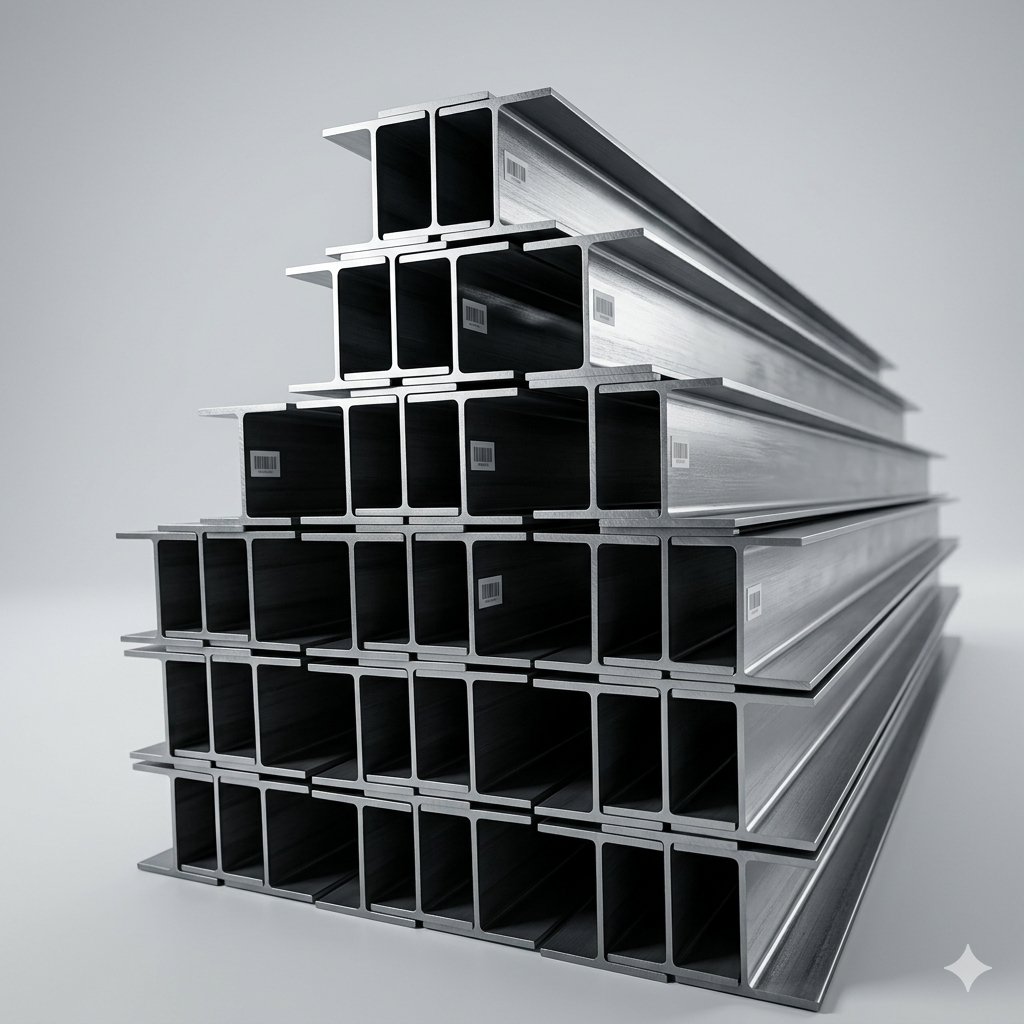
Our premium-grade H beam selection represents the absolute engineering and metallurgical benchmark for large-span industrial factory frames, multi-story commercial steel structures, maritime port infrastructure, heavy-duty machinery chassis, and civil engineering bridge columns. Engineered precisely to comply with strict international B2B technical plant specifications and national structural building codes, these hot-rolled and submerged arc-welded (SAW) profile sections function as the critical load-bearing backbone within dynamic load building networks. By optimizing the distribution of steel mass across the parallel flange planes and perpendicular web structures, our universal profiles ensure maximum flexural section moduli, minimizing overall dead-weight parameters while securely maintaining extended architectural spans.
As an authoritative global supplier and direct exporter of premier structural steel products, our manufacturing plant coordinates continuous multi-pass rolling trains, computer-guided cooling beds, and advanced hydraulic flange-straightening arrays. This specialized production sequence guarantees impeccable dimensional squaring constants, zero warp distortions along the flange faces, and uniform web-to-flange transitions that eliminate stress concentration weak points. Whether your enterprise handles volume wholesale warehouse distribution across regional steel service hubs, or procures directly for tier-one infrastructure building tenders, our H section beams offer unparalleled mechanical safety limits, certified weldability characteristics, and highly competitive cost-to-volume ratio frameworks.
Core Engineering Strengths of Our Structural H Beams
1. Optimized Parallel Flange Configuration for Superior Section Modulus
Unlike standard I-beams with tapered interior flange faces, our universal H section profiles feature completely parallel outer and inner flange lines. This structural design drastically multiplies the cross-sectional moment of inertia across both the strong and weak axes, providing exceptional resistance to lateral torsional buckling, bending moments, and heavy compressive forces.
2. Continuous Hot-Rolled Forming to Minimize Internal Residual Stress
Internal stress concentration points can induce severe structural deformation or crack propagation during field fabrication. Our beams are continuously rolled in monolithic formats from high-purity cast billets under computer-controlled thermal lines. This uniform material reduction ensures isotropic mechanical qualities and consistent thickness boundaries throughout the cross-section.
3. High-Capacity Submerged Arc Welding (SAW) for Custom Non-Standard Layouts
When civil blueprints demand jumbo asymmetric profiles or wall heights exceeding standard hot-rolled limits (up to 900mm), our automatic SAW line provides full flexibility. Utilizing computerized laser tracking, three-wire submerged arc welding systems deeply fuse independent thick plate blanks, achieving 100% weld joint efficiency with zero metallurgical voids.
4. Verified Chemistry & Low Carbon Equivalents for Flawless Field Weldability
We source certified steel melts from top-tier national metallurgical mills to fully block volatile recycled scrap metal lines. By strictly preserving low carbon equivalent values (CEV), our beams facilitate smooth manual or robotic field arc welding, preventing hydrogen embrittlement defects and maintaining joint mechanical integrity under shivering thermal contractions.
Technical Specifications & Structural Dimensions
We provide full customizable capabilities to support your target bidding frameworks and regional market demands. Review our standardized architectural specifications below:
| Technical Properties | Standard Hot Rolled H-Series | Welded Custom Heavy Duty Series |
|---|---|---|
| Available Steel Grades | Q235B, Q355B, ASTM A36, S275JR, SS400 | Q355B, ASTM A572 Grade 50, S355JR, S355JO |
| Section Height Range (H) | 100 mm – 900 mm | 200 mm – 1500 mm (Jumbo Industrial Girders) |
| Flange Width Range (B) | 100 mm – 300 mm | 150 mm – 600 mm (Extra-Wide Rigid Clamping Plates) |
| Web Thickness (t1) | 5.0 mm – 16.0 mm | 6.0 mm – 30.0 mm (Reinforced High Shear Webbing) |
| Flange Thickness (t2) | 7.0 mm – 28.0 mm | 10.0 mm – 50.0 mm (Heavy Structural Bearing Support) |
| Standard Delivery Lengths | 5.8m, 6.0m (Optimized for 20ft Containers) | 11.8m, 12.0m, 15.0m (40ft HQ or Bulk Break Ship) |
| Surface Finish Styles | Black Raw, Shot Blasted (Sa 2.5), Shop Primer | Hot-Dipped Galvanized (ASTM A123 / ≥ 85 μm) |
| Dimensional Frameworks | GB/T 11263, ASTM A6, EN 10034, JIS G3192 | Full Mill Certification (MTC 3.1) & SGS Trace File |
Primary Global Heavy Structural Applications
Our structural H sections operate as primary material columns specified by structural engineers and infrastructure contractors across massive sectors globally:
- Multi-Story Commercial Steel Framing: Utilized extensively as core vertical loading columns and major structural horizontal floor girders inside high-rise office towers, residential steel modules, and public hubs.
- Industrial Portal Frame Warehouses & Sheds: Deployed as primary portal columns and wide rafters to securely handle massive uniform static crane loads, high wind forces, and external roof snow drops.
- Heavy Pipe Racks & Refinery Superstructures: Specified natively by petrochemical and chemical plant engineers to construct rigid, multi-tier utility conduits and high-elevation processing platforms that survive continuous vibrations.
- Infrastructure Foundation Piling & Retaining Walls: Fabricated into heavy foundation H-piles and sheet pile interlocking shoring walls to distribute immense building loads directly down to solid subterranean rock strata.
B2B Wholesale Supply Chain Quality Control & Export Ocean Freight Logistics
We optimize our post-production leveling and maritime shipping workflows specifically to transport heavy beam payloads securely while insulating active profile faces from marine moisture rust and shifting shocks:
-
- High-Tension Steel Strand Bundle Strapping: H section profiles carry immense concentrated weight lines. We group sections in matching dimensions, packaging them into tight bundles bound with multiple pneumatic high-strength steel strands to stop lateral friction slide during ocean travel.
- Bespoke Heavy Lifting Loop Alignments: To facilitate rapid forklift and crane operations at your local construction yards or port bays, bundles are fitted with integrated heavy nylon lifting loops, avoiding direct hook scratching on the metal coatings.
- Container Payload Balancing & Anti-Slide Shoring: Our logistics engineering team calculates center-of-gravity distributions inside 20ft containers and 40ft HQ lines, applying heavy timber square bracing, nylon tie straps, and steel wire choking lines to secure the cargo and avoid maritime delays.
Frequently Asked Questions (FAQ)
Q1: What are the fundamental structural and mechanical differences between an H beam and a standard traditional I-beam?
A1: The primary difference lies in the geometric layout of the flange profiles. A traditional I-beam features narrow flanges that slope inward along the interior faces (typically a 1:10 slope), making it highly optimized for purely vertical bending loads along the major axis, though it has low stability against lateral twisting. An H beam incorporates wide, completely parallel flanges that extend further from the neutral axis. This flat, wide configuration balances the radius of gyration across both the strong and weak axes, providing significantly higher structural resistance to bending moments, lateral torsional buckling, and multi-directional wind loads, which makes it ideal for complex vertical building columns.
Q2: When should an engineering blueprint specify a hot-rolled H section versus a submerged arc welded (SAW) custom beam?
A2: Hot-rolled H beams are monolithic structures formed directly from heated billets in rolling mills. This process minimizes residual internal stresses and maximizes economic efficiency, making them standard for universal building columns up to a maximum section height of 900mm. However, if your civil blueprints require non-standard dimensions, asymmetric flanges, heavy internal web stiffener plates, or jumbo section heights exceeding 1000mm, a submerged arc welded (SAW) custom beam is required. Welded variants allow thick plate elements to be combined into custom-tailored cross-sections that match specialized architectural load profiles.
Q3: Under what operating field conditions should a contractor upgrade order specifications to a Hot-Dipped Galvanized (HDG) coating?
A3: For traditional enclosed commercial buildings, climate-controlled warehouses, or framing fully encased in drywall, standard raw black steel treated with a light shop primer provides exceptional service lifespans. However, if your project involves open-air industrial cat-walks, chemical plant pipe racks, wastewater aeration tanks, or coastal maritime shipping facilities, upgrading to hot-dipped galvanizing is critical. Diping the entire steel matrix into molten 450°C zinc creates a heavy iron-zinc alloy coating (≥ 85μm thick) that blocks atmospheric rust, providing reliable anti-corrosive protection for over 40 years.
Q4: What is your standard factory minimum order volume (MOQ) and typical delivery lead time for custom drilled beams?
A4: For standard stocking profiles (such as common HW/HM/HN cross-sections in lengths of 6.0m or 12.0m), our baseline production MOQ is 5.0 to 10.0 metric tons per specific gauge width, matching continuous mill sequences, with container loading wrapping inside 10 to 15 days post deposit verification. For custom automated three-dimensional CNC bolt-hole drilling, miter end bevel cuts, or heavy welded configurations, mass production lead times typically average 20 days to balance machine programming setups and testing loops.
Get Factory-Direct Wholesale Price & Free Samples
Are you searching for a stable, high-capacity Chinese manufacturer to optimize your procurement costs? Partner with us for premium Stainless Steel Pipes featuring heavy-duty, high-pressure, and superior corrosion-resistant quality. We ensure full compliance with international industrial fluid piping, structural engineering, oil & gas transit, and chemical processing standards, backed by seamless global supply chain service.
- Flexible Tiered Pricing: Enjoy massive discounts and competitive FOB/CIF/CFR quotes for full container loads (20GP/40HQ) to maximize your inventory budget.
- 100% Free Samples: Test our quality firsthand. We offer premium Stainless Steel Pipe samples (available in SS304, SS316, SS316L, and duplex steels) featuring precise outer diameters (OD), uniform wall thicknesses (Schedule/WT), flawless bead-removed welding seams, or high-precision seamless configurations. Perfect for local pipe distributors, mechanical engineering contractors, or industrial supply wholesale verification.
- Guaranteed Fast Lead Time: Our advanced automatic continuous tube welding lines, high-precision cold-drawing machinery, automated eddy current testing equipment, and bright annealing furnaces ensure prompt manufacturing and on-time shipment.
- Customized Packaging: Prevent pipe bending, ovality deformation, end thread damage, or surface scratching during long-distance ocean transit. We use plastic end caps, individualized knit-fabric sleeves or plastic wraps, and heavy-duty steel-strapped bundles or reinforced wooden crates on sturdy pallets.