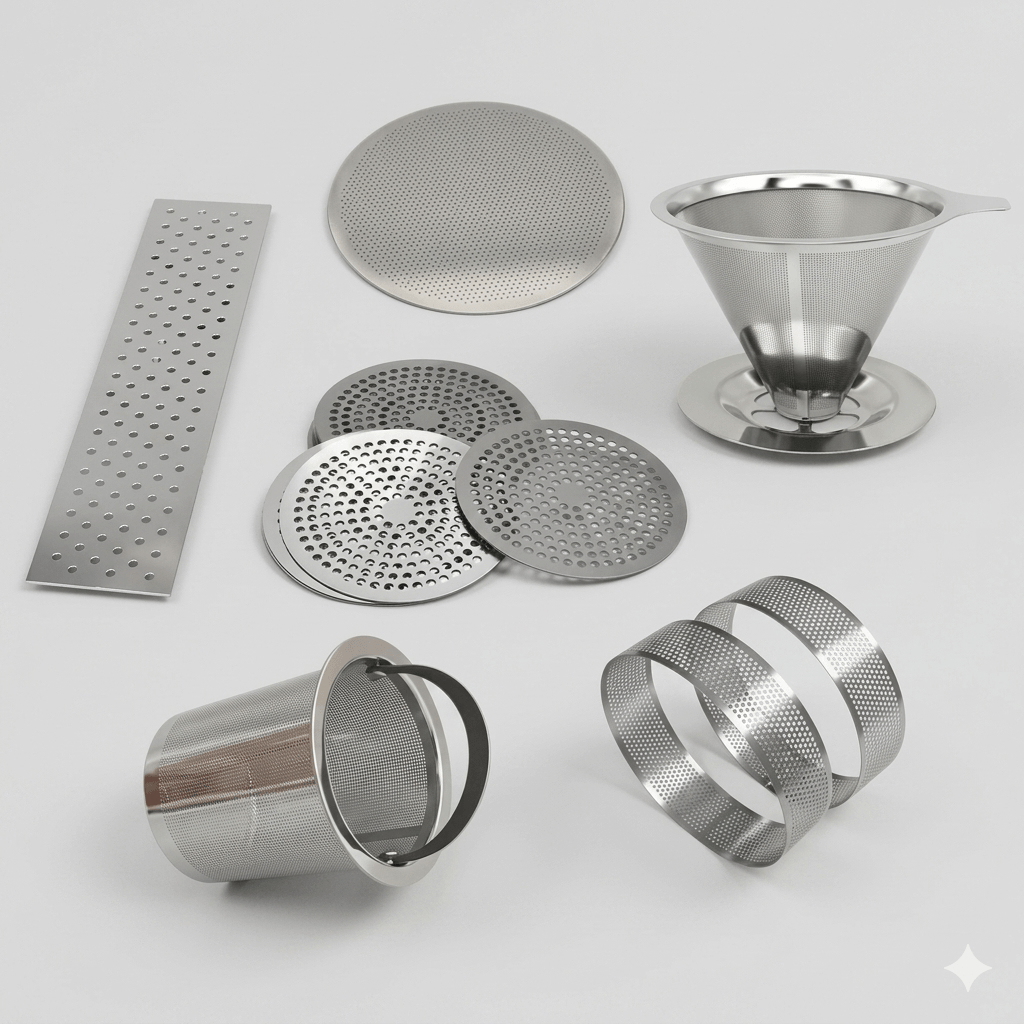

Ultra-Precision Photo Etched Metal Filter Screen for Advanced Microfiltration Systems
In the fields of high-precision fluid purification, aerospace component validation, and chemical process engineering, filtration mediums must perform with micro-level accuracy under intense cross-flow stresses. Our premium Etched Metal Filter Screen provides an advanced, unyielding solution designed to surpass the inherent limits of mechanical punching and woven wire cloths. By using automated industrial photolithography patterns to transfer digital designs directly onto solid stainless steel or copper foils, we dissolve unwanted metal with balanced acid chemistry, leaving behind an incredibly complex, flat micro-pore network with zero physical tool contact.
As a leading certified first-tier manufacturer of photo-etched micro-components, we control the reaction environment within dust-free cleanrooms. This enables us to regularly achieve precision tolerances within ±10 microns. Unlike woven fabrics that suffer from shifting wires or unravelling strands when custom cut, chemically milled panels are integrated from a single solid sheet. This ensures absolute stability and allows you to integrate custom blank borders or localized solid attachment fields seamlessly, meeting the strict technical demands of high-end global enterprises.
Advanced Engineering Advantages of Chemically Etched Filter Elements
1. Flawless Burr-Free, Stress-Free Geometric Perforations
Traditional stamping or laser burning forces intense physical loads and thermal stress onto thin metal sheets, which often leads to microscopic tearing, localized hardening, and jagged edge burrs. Chemical photo-etching selectively breaks down the metal at the atomic level, yielding totally smooth aperture transitions that prevent particle accumulation and simplify automated maintenance washing.
2. Tailored Tapered/Conical Pores for High Anti-Clogging Action
By altering our chemical spray speed ratios across the top and bottom faces of the sheet material, we can produce specialized conical or tapered filter holes. This unique wedge-shaped geometry creates a widening clearance pathway for fluid dynamics. Particles small enough to clear the initial micron aperture slip right through without wedging inside the core, significantly extending operational lifetimes.
3. Unlimited Layout Freedom & Integrated Solid Mounting Frame Zone
Since our production relies on chemical photolithography rather than expensive solid tool dies, creating custom border zones, localized variable mesh sizes, or complex structural shapes adds no extra tooling costs. We can build dense micro-hole fields that transition smoothly into thick, unperforated outer frames, giving your automated clamping tracks or spot-welding components high structural integrity.
Technical Specifications & Micron Micro-Hole Matrices
| Product Code SKU | Material Alloy Basis | Foil Thickness (mm) | Min Pore Size / Micron | Aperture Hole Shape | Aperture Accuracy Tolerance |
|---|---|---|---|---|---|
| EMS-SS-316L03 | Stainless Steel 316L | 0.03 mm | 30 Micron (0.03 mm) | Round Cylindrical | ± 0.008 mm |
| EMS-SS-30405 | Stainless Steel 304 | 0.05 mm | 50 Micron (0.05 mm) | Anti-Clogging Conical | ± 0.010 mm |
| EMS-CU-BR10 | Pure Copper / Brass | 0.10 mm | 100 Micron (0.10 mm) | Round / Hexagonal | ± 0.015 mm |
| EMS-SS-316L20 | Stainless Steel 316L | 0.20 mm | 200 Micron (0.20 mm) | Slotted Oblong Bars | ± 0.020 mm |
| EMS-TI-M30 | Pure Medical Titanium | 0.30 mm | 300 Micron (0.30 mm) | Precision Square Grid | ± 0.025 mm |
Primary High-Tech & Precision Filtration Applications
Our micro photo-etched filter screens are trusted high-performance components integrated within advanced engineering segments globally:
-
- Semiconductor High-Purity Insets: Deployed inside cleanroom gas delivery tubes and wafer washing devices to reliably capture microscopic crystallite slurry elements.
- Medical Fluid & Biosensor Analysis: Serving as sterile, non-reactive micro-filtration plates within dialysis equipment, clinical blood pumps, and high-purity medical vapor inline strainers.
- Commercial Consumer Beverage Filters: Formed into ultra-fine reusable espresso basket screens and premium industrial fruit juice filters that deliver sediment-free clarity without oil flavor absorption.
- Aerospace Fuel & Hydraulic Valves: Installed inside precision jet nozzles and hydraulic thruster systems to trap particle contamination while ensuring smooth flow under high pressure drops.
On-Site Mechanical Handling & Assembly Best Practices
To avoid creasing thin-gauge foil grids and completely eliminate bypass leak hazards, ensure field technicians adhere to these handling steps:
- Vacuum Tool Deployment: Since ultra-thin etched foils (under 0.1mm) are highly sensitive to skin oils and pressure markings, always use clean vacuum suction pick-ups or silicone-coated tweezers.
- Ultrasonic Resistance Welding: When securing thin etched micro-discs into solid thick support tubes, use precision ultrasonic or micro-laser spot-welding intervals to prevent thermal deformation along the mesh margins.
- Directional Conical Flow Setup: For systems using anti-clogging tapered pores, make sure the narrower aperture face is oriented toward the incoming fluid to enable self-cleaning performance.
- Chemical Cleaning Protocols: Clean dirty filters with ultrasonic solvent bath immersion or reverse liquid backwash tracking. Avoid scraping with coarse wire brushes, which can damage the precision micro-apertures.
Enterprise Supply Stability, Automated Cleanroom Quality Controls & Air Cargo Packing
Fulfilling large-scale industrial contract tenders for electronic, automotive, or pharmaceutical processing enterprises requires meticulous quality tracking and immaculate chemical cleanliness. At our state-of-the-art cleanroom photo-chemical milling facility, every run of micro filter screens passes through advanced inline Automated Optical Inspection (AOI) arrays to detect microscopic mesh variances, followed by multi-stage cleanroom ultrasonic hot de-ionized water rinses to guarantee complete residue elimination.
To maintain a clean environment during long-distance international air transport, we pack precision micro-etched components inside anti-static vacuum-sealed bags with acid-free protective sheets separating each layer. Stacks are set into thick, shock-absorbing high-density expanded polystyrene (EPS) boxes and locked within extra-tough seaworthy or air-freight plywood cases. We provide comprehensive traceability documentation, including Mill Test Certificates (MTC) and surface scan profiles, ensuring your manufacturing line receives high-quality components ready for direct deployment.
Frequently Asked Questions (FAQ)
Q1: What is the technical ratio limit between material sheet thickness and minimum etched pore diameter?
A1: In standard chemical photo-etching production, the minimum hole diameter (aperture) should typically be equal to or greater than the raw material sheet thickness (Pore Size ≥ Thickness). For example, to achieve a precise 50-micron micro-hole matrix, we typically utilize a thin foil sheet with a maximum thickness of 0.05mm. If your design requires a thick, load-bearing plate with microscopic pores, please contact our engineering staff to explore our composite multi-layer diffusion bonding or alternative multi-stage micro-drilling options.
Q2: How do photo-etching tooling setup costs compare to traditional stamping die charges for complex custom filter grids?
A2: Photo-etching tooling uses digital photolithography films rather than heavy mechanical steel stamping dies, which can save thousands of dollars in initial development costs. This setup allows engineering departments to test multiple pore variations or complete layout changes in just 2 business days by simply modifying a CAD file. This approach eliminates expensive re-tooling charges, making it cost-effective for both small R&D sample batches and massive wholesale B2B runs.
Q3: Can your chemical etching line process complex geometric openings like elongated hexagonal arrays or slots?
A3: Yes, absolutely. Because chemical milling removes material evenly across the film layout without physical contact, it can form complex geometric shapes such as honeycomb hexagons, slotted rectangles, star matrices, or custom logos. This technique maintains crisp corner resolutions and perfect structural layout consistency, regardless of how intricate your CAD draft is.
Q4: What is your standard factory minimum order quantity (MOQ) for custom-engineered etched components?
A4: Since the photo-chemical process utilizes digital film preparation, our MOQ is highly adaptable. For standard R&D engineering evaluations or low-volume custom medical trials, we support short-run batches starting at just 5 to 10 sheets of parts. For large-scale manufacturing runs, our prices scale down significantly with larger sheet volumes. Reach out to our sales engineering desk with your CAD blueprints for a detailed cost analysis.
Get Factory-Direct Wholesale Price & Free Samples
Are you searching for a stable, high-capacity Chinese manufacturer to optimize your Etched Metal Filter Screen procurement costs? Partner with us to enjoy premium burr-free, smooth-finish, and perfectly flat quality compliant with industry filtration standards and seamless global supply chain service.
- Flexible Tiered Pricing: Massive discounts and competitive FOB/CIF/CFR quotes for full container loads (20GP).
- 100% Free Samples:Quality, dimensional flatness, and micron-level aperture precision testing samples available for your local high-precision filtration project or distribution verification.
- Guaranteed Fast Lead Time:Advanced automated chemical etching lines and precise optical inspection systems ensure prompt manufacturing and on-time shipment of your etched metal filter screens.
- Customized Packaging: Marine-grade rust-proof dual packing (waterproof paper inside + PE shrink film outside) with heavy-duty reinforced pallets to prevent transit damage and mesh deformation.