
Industrial-Grade Perforated Filter Screen for Heavy-Duty Fluid & Gas Purification
In high-pressure fluid dynamics, chemical processing channels, and industrial HVAC environments, filtration elements must withstand intense continuous velocity and sudden explosive backwash stresses. Our premium Perforated Filter Screen series represents the pinnacle of CNC sheet perforation technology. Unlike traditional woven wire cloth meshes that suffer from shifting wires, non-uniform gaps, or perimeter fraying under stressful structural loads, our punched filter screens are manufactured from solid metal plates. This ensures a monolithic, high-strength framework that holds its absolute micron pore size throughout its operational lifetime.
As a leading first-tier direct-factory manufacturer, we control every parameter of the perforation matrix utilizing advanced multi-pin computer-guided presses. Every sheet is treated with continuous inline roller leveling to counteract internal metal stress and guarantee exceptional flatness. This allows the mesh sheets to feed perfectly into your automated rolling, cylinder-forming, or laser-welding assembly stations. From chemical hydraulic strainers and automotive oil cores to municipal water intake screens, our perforated elements deliver uncompromising durability and precision.
Engineered Performance Advantages of Our Punched Filter Screens
1. Rigid Crush-Resistant Structure for High-Pressure Differentials
When pleated filter elements encounter viscous oils or heavy sediment loads, pressure drops multiply rapidly. Our thick-gauge perforated sheet screens act as an unyielding structural backbone, preventing thin-film microfiltration membranes from sagging, wrinkling, or crushing under crushing hydraulic forces.
2. High Open Area & Low Initial Resistance Drop
By optimizing the hole layout configuration using a standard 60-degree staggered triangular matrix, we maximize the filtration open area (up to 65%). This precise engineering allows liquid or gas streams to pass smoothly with minimum turbulence, keeping system throughput high and power consumption low.
3. Clean Ultrasonic Degreasing & Smooth Burr-Free Holes
Filtration systems require a clean fluid path. Our post-production lineup routes finished screens through secondary mechanical wide-belt sanders to shave down breakout burrs. This is followed by full industrial ultrasonic cleaning baths that remove 100% of stamping lubricants, guaranteeing chemical safety for sensitive pharmaceutical or food-safe applications.
Technical Specifications & Standard Manufacturing Dimensions
| Model SKU | Material Alloy Option | Sheet Thickness (mm) | Hole Shape & Diameter | Pitch / Center Distance | Calculated Open Area % |
|---|---|---|---|---|---|
| PFS-SS-R05 | Stainless Steel 316L | 0.4 mm | Round Ø 0.5 mm | 1.2 mm (Staggered) | 15.7% |
| PFS-SS-R15 | Stainless Steel 304 | 0.8 mm | Round Ø 1.5 mm | 3.0 mm (Staggered) | 22.6% |
| PFS-GI-R30 | Galvanized Steel | 1.5 mm | Round Ø 3.0 mm | 5.0 mm (Staggered) | 32.6% |
| PFS-SS-S50 | Stainless Steel 316 | 2.0 mm | Square 5.0 x 5.0 mm | 8.0 mm (Straight Line) | 39.0% |
| PFS-CS-SL220 | Carbon Steel HRPO | 3.0 mm | Slotted 2.0 x 20.0 mm | Custom Grid Pitch | 28.4% |
Primary Industrial Sectors & Fluid Filtration Deployments
Our heavy-gauge perforated screen matrices are integrated within critical purification frameworks globally:
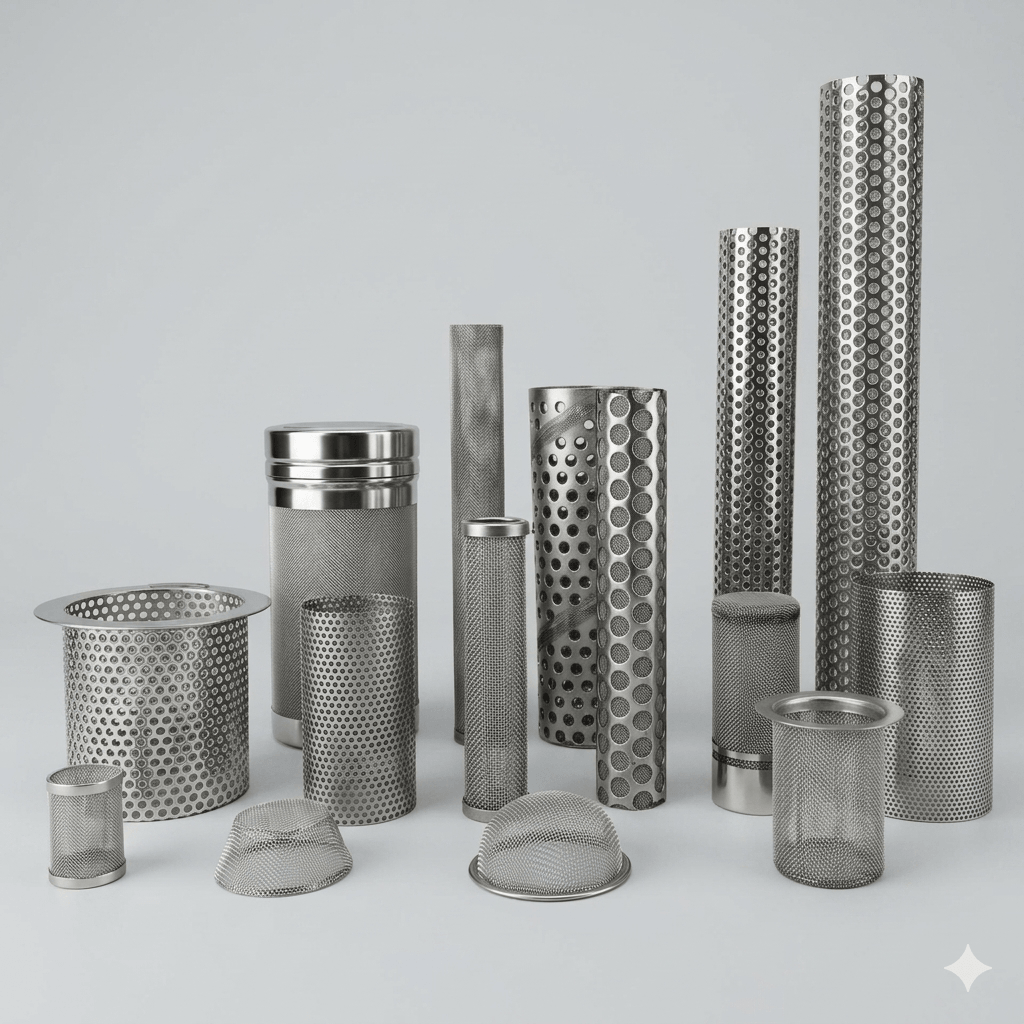
- Hydraulic Fluid & Lubrication Cartridges: Welded into perforated internal core tubes to support micro-fiber filters inside high-pressure machineries.
- Industrial Water Strainers & Intake Manifolds: Forming large basket strainers for municipal sewage treatment, cooling tower inlets, and sea-water desalination plants.
- Chemical & Petrochemical Processing: Fabricated using food-grade SUS316L to withstand aggressive acids, alkaline mixers, and raw solvent processing lines.
- Automotive & Aerospace Fuel Networks: Serving as precise micro-hole backplates inside diesel engine pumps and jet thrust thruster valves to filter microscopic particulate contaminants.
On-Site Mechanical Winding & Tube Assembly Best Practices
To avoid local stress distortion and eliminate risk of fluid bypass leakages during tube assembly, recommend these technical protocols to your fabrication teams:
- Fastener Metal Compatibility: Always utilize matching metallurgy. Secure stainless steel filter plates with stainless steel hardware, or non-reactive welding filler wires, preventing localized galvanic corrosion cell formation.
- Pre-Milled Border Clamping: When feeding sheets into automatic roller benders to form perforated filter cylinders, ensure clamping blocks grip onto the solid, unperforated margins. This prevents deformation of the micro-holes near the seam line.
- Resistance Lap Welding: Program automated seam laser-welders to complete tack intervals precisely across the solid unperforated margins. This ensures complete fusion with zero burn-through holes or slag residues.
- Optimal Flow Path Orientation: For centrifugal sorting or separation basket strainers, verify that the smooth punch entry side faces the incoming raw fluid to reduce material abrasion and build-up.
Industrial Bulk Palletization, Quality Auditing & Seaworthy Anti-Rust Packaging
Fulfilling large-scale international contract tenders for filter distributors and factory assembly lines requires strict quality tracking. At our automated sheet processing complex, finished perforated panels undergo high-pressure chemical bath degreasing to remove oil lubricants, followed by multi-point digital checking to confirm consistent hole spacing and diameters before moving to the packaging bay.
To avoid oxidation or surface scraping during long trans-oceanic container shipping voyages, sheets are tightly stacked, covered in heavy moisture-absorbing VCI anti-rust paper wrap, and bound securely inside fully enclosed heavy-duty export plywood crates. The payload is reinforced with corner boards and bound tightly with high-tensile steel straps on ISPM-15 compliant pallet bases. This premium packaging approach keeps your filter screens pristine and perfectly ready for direct manufacturing deployment upon arrival.
Frequently Asked Questions (FAQ)
Q1: What is the fundamental physical limitation regarding hole diameter versus sheet thickness when ordering filter screens?
A1: As a standard mechanical rule, the hole diameter (aperture) should be equal to or greater than the raw material plate thickness (Aperture ≥ Thickness). For example, trying to mechanically punch a 0.5mm micro-hole directly through a 1.0mm thick high-tensile stainless steel sheet will apply excessive force that can easily snap mechanical punch pins. If your project demands microscopic holes through heavy sheets, please talk to our sales staff about our custom photo-chemical etching or multi-axis CNC laser-cutting capabilities.
Q2: Can you provide customized solid unperforated border zones on slit coil sheets for automated automated rolling machines?
A2: Yes, absolutely. Utilizing our state-of-the-art CNC precision perforation lines, we can leave custom solid unperforated borders matching your exact CAD blueprints on any or all sides of the sheet. This solid field provides clean surface space for automatic lap seam welding, mechanical clamping, or edge slotting, eliminating the risk of crushing or distorting the filter holes.
Q3: How does your factory control the breakout burrs around the exit side of the punched strainer holes?
A3: High-speed mechanical punching naturally creates a microscopic breakout edge or burr on the underside exit face of the metal sheet. To resolve this issue, our production line treats all export filter sheets with automated wide-belt sanding and edge-smoothing deburring machinery. This ensures both faces of the panel are safe, smooth, and touch-friendly, preventing fibers or debris from catching on raw metal points.
Q4: What is the typical factory minimum order quantity (MOQ) for international bulk orders?
A4: For standard sheet and hole configurations kept in our active master warehouse inventory (such as common 4ft x 8ft galvanized panels), the MOQ is highly flexible. For specialized custom dimensions, rare metal alloys, or unique micro-hole geometries requiring custom punch dies, our standard manufacturing line setup MOQ typically requires 50 sheets or a single combined freight pallet load minimum.
Get Factory-Direct Wholesale Price & Free Samples
Are you searching for a stable, high-capacity Chinese manufacturer to optimize your Perforated Filter Screens procurement costs? Partner with us to enjoy premium bright, smooth-finish, and perfectly flat quality compliant with industry filtration standards and seamless global supply chain service.
- Flexible Tiered Pricing: Massive discounts and competitive FOB/CIF/CFR quotes for full container loads (20GP).
- 100% Free Samples: Quality, dimensional flatness, and perforation pattern/pitch precision testing samples available for your local industrial filtration project or distribution verification.
- Guaranteed Fast Lead Time:Advanced automated high-speed CNC punching presses and precise flattening/shearing lines ensure prompt manufacturing and on-time shipment of your perforated filter screens.
- Customized Packaging: Marine-grade rust-proof dual packing (waterproof paper inside + PE shrink film outside) with heavy-duty reinforced pallets to prevent transit damage, burr damage, and panel bending.